
Although mobility funding currently doesn’t include a specific incentive for slower travel, recipients can still plan their journeys in ways that may increase the amount of funding they receive. The funding recipient is free to choose their preferred mode of transport. When applying, the applicant specifies their destination and travel dates. They can then plan additional stages of the journey – for example, if travelling by land or sea requires overnight stays along the way, this may qualify for a higher grant.
The challenges of Nordic topography
Because of the Nordic Region’s topography and transport infrastructure, travelling overland is not always a practical option within the Nordic and Baltic countries. Nevertheless, many artists prefer to travel more slowly – either by land or by sea – whenever their destination and schedule allow.
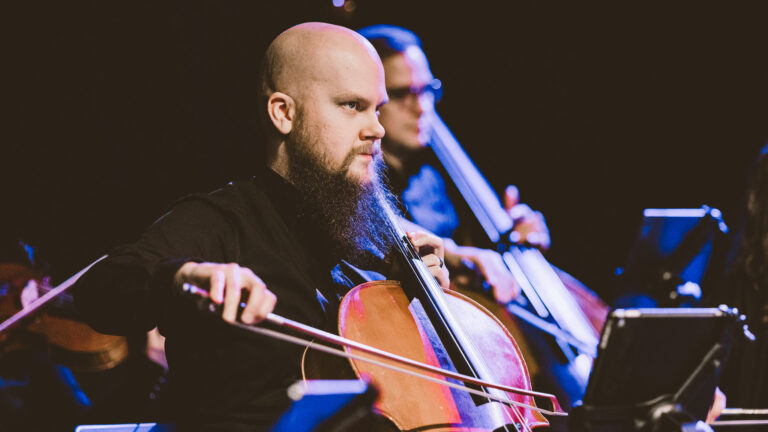
“If the journey takes less than a day and I end up in a completely different country, I wouldn’t really call that particularly slow. In the case of this grant, for example, it actually made good practical sense not to fly from Turku to Riga. I would have had to buy a separate airline ticket for my cello, which would have increased the cost. Travelling slowly is genuinely great, as long as you have enough time,” says Teemu Mastovaara.
“Whenever possible, I want to avoid flying. On this trip it was feasible in terms of both the timetable and the budget, so why not? Avoiding air travel is better for the environment. Since the plan was to transport Ensemble for New Music Tallinn’s instruments and other equipment from Tallinn to Riga by car, I was also able to act as a second driver and keep the main driver company,” Teemu explains.
Slower travel benefits creativity
According to Teemu, travelling more slowly also adds value to artistic work. A longer journey gives you time to notice changes in the landscape and experience cultural differences. In his view, this allows travellers to gain much more from the journey, which is likely to be reflected in their artistic work at some point. He also points out that
travelling together around the clock creates opportunities to build deeper relationships with colleagues.
The Nordic Council of Ministers’ goal is for the Nordic Region to be the most sustainable and integrated region in the world by 2030 at the latest. Whilst these sustainability goals may at times appear to conflict with professional artists’ need for international engagement, the Mobility Programme recognises that responsibility for sustainability cannot rest solely with individual artists. Applications are assessed primarily on the basis of the applicant’s professional merits, and applicants are not penalised for choosing to fly. However, applicants are required to explain and justify their choice of transport in relation to the activities covered by their application, encouraging them to reflect on their role from a broader sustainability perspective.
Teemu takes a pragmatic view.
“Generally speaking, I would say that there’s a genuine willingness within my field to reduce unnecessary travel, although there’s still room for improvement. Most of the colleagues I know – especially those working in contemporary art music – prefer to avoid flying. Across the music industry as a whole, the picture is probably more mixed: some avoid flying, others don’t. At the same time, it’s a fact that working internationally brings significant advantages: there is greater demand, so if you want to make a living and support yourself and your family, it may be necessary not only to work locally and nationally but also to seek opportunities abroad, organise international projects, or take part in them. In those situations, travel often has to be arranged in whatever way is feasible given the available time and resources,” Teemu ponders.
The Nordic-Baltic Mobility Programme for Culture encourages environmentally friendly modes of travel. See the application deadlines and find out more about the mobility grant at https://www.nkk.org/en/mobility-funding/.
*The production Qullaq was created by Scottish violinist Aidan O’Rourke in collaboration with three Greenlandic artists: Nive Nielsen, Hans-Henrik Suersaq Poulsen, and Mikè Fencer Thomsen. Directors: Valerio Peroni and Alice Occhiali. The work has toured several countries and is performed by different ensembles in each location. In the Riga production, the performers included several different participants: Ensemble for New Music Tallinn (represented by Teemu Mastovaara himself), local string musicians, and the Baltic Music Days and Nordic Music Days festivals.